Press Release 24/03/2025
SCHOOL ACTIVITY STATISTICS. 2024
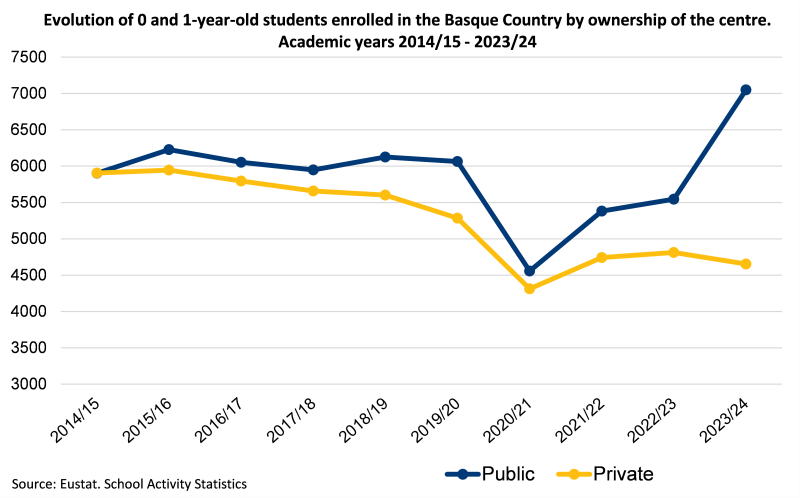
The number of 0 and 1 year olds enrolled in public education centres in the Basque Country rose by 27% in the 2023/24 academic year
Primary Education saw student numbers fall by 10,000 in five years
In the 2023/24 academic year, there were 405,616 enrolments in formal non-university education in the Basque Country, a very similar figure to that for the previous academic year, according to Eustat data.
However, the evolution was different depending on the level of education. Primary Education saw 2,612 fewer enrolments than the previous year, a drop of 2.1%, marking five years of decline in which it lost nearly 10,000 students. On the other hand, both Compulsory Secondary Education and Vocational Training recorded the highest enrolment figures in the last twenty years, with 90,000 and 46,000 enrolments, respectively.
In general, Specialised Education remained largely unchanged and the overall increase of 1.1% was due to the recovery in Sports Education, which regained the more than 300 students it lost in the 2022/23 academic year.
Students enrolled in non-university education in the Basque Country by study level, according to ownership of centre. 2023/24


| | Total | Public | Private | Variation with respect to the previous course (%) |
| TOTAL | 405.616 | 227.751 | 177.865 | 0,0 |
| General teaching | 377.088 | 200.389 | 176.699 | -0,0 |
| Infant education | 73.031 | 39.894 | 33.137 | -1,0 |
| Primary education | 121.539 | 63.289 | 58.250 | -2,1 |
| Obligatory secondary education | 90.335 | 43.011 | 47.324 | 1,6 |
| Basic vocational training | 5.283 | 1.601 | 3.682 | 7,7 |
| Baccalaureate | 32.575 | 15.599 | 16.976 | 0,3 |
| Professional Training middle grade | 16.305 | 10.284 | 6.021 | 1,7 |
| Intermediate vocational training courses | 39 | 25 | 14 | -33,9 |
| Professional Training higher grade | 24.669 | 14.428 | 10.241 | 4,1 |
| Higher degree FP specialization courses | 434 | 301 | 133 | 70,9 |
| Special education | 1.779 | 1.008 | 771 | 5,5 |
| Adult education | 11.099 | 10.949 | 150 | -2,0 |
| Special teaching | 28.528 | 27.362 | 1.166 | 1,1 |
| Language studies | 23.763 | 23.763 | - | -0,3 |
| Artistic studies - music | 2.452 | 1.808 | 644 | -3,4 |
| Artistic studies - dance | 160 | 160 | - | 15,9 |
| Plastic arts and design teachings | 875 | 582 | 293 | 9,5 |
| Sports studies | 1.218 | 989 | 229 | 46,9 |
| Arts Education in dramatic art | 60 | 60 | - | -4,8 |
Date March 24, 2025
Source: Eustat. School activity statistics
There was an upturn in the number of 0 and 1 year olds enrolled in public centres
The data on Early Childhood Education deserve further analysis. As a whole, this stage saw a decrease in enrolment of 1%, but the number of 0 and 1 year olds enrolled in education increased by 13%. However, there were significant differences between the public and private sectors.
The entry into force of free public nursery schools in the 2023/24 academic year led to a notable increase in demand. Specifically, the number of children under 1 year of age enrolled in public centres increased by 57% compared to the previous academic year, rising from 1,111 to 1,746. The increase in the number of 1 year olds enrolled was close to 20%.
Meanwhile, private centres also recorded a rise in enrolments of children under 1 year of age, albeit very moderate, as there were barely 100 more enrolments than in the 2022/23 academic year. As regards pupils in the 1 year-old age group, enrolments in private sector schools were down 7%.
There was parity in the Science and Technology pathway of Upper Secondary Education
Royal Decree 243/2022, establishing the structure of Upper Secondary Education, came into full effect in the 2023/24 academic year. Among other things, this regulation modified the pathways that can be taken in Upper Secondary Education, and the main change in this regard was the creation of the General pathway, designed for those seeking a more comprehensive and flexible education, which allows students to create different educational routes by choosing subjects from various pathways.
Thus far, this new pathway has not been well received in the Basque Country, since only 451 students (1.4% of the total) opted for it. The Science and Technology pathway, on the other hand, attracted more than half of students in Upper Secondary Education.
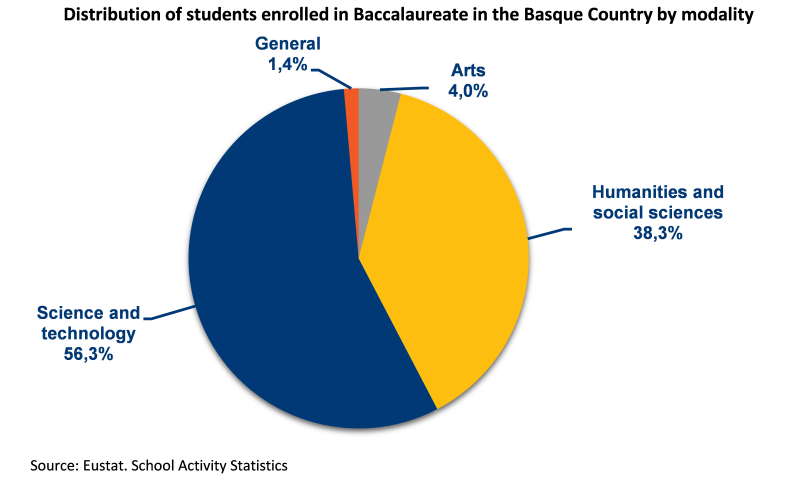
When it came to choosing an Upper Secondary Education pathway, girls and boys acted slightly differently. 62% of boys chose the Science and Technology pathway, eleven percentage points more than girls (51%). In contrast, the proportion of women studying Humanities and Social Sciences (42%) was eight points higher than that of men (34%). The Arts pathway was in the minority for both sexes, but the percentage of women who opted for this route (6%) was triple that of men. In absolute terms, this resulted in a major imbalance in classrooms, as eight out of ten students in this pathway were women. Lastly, only 2% of men and 1% of women chose the General pathway.
In the 2023/24 academic year, 41,447 people enrolled in Intermediate or Advanced Level Vocational Training, including specialisation courses, 1,400 more than in 2022/23. Courses belonging to the occupational family of Health were the most popular, with a total of 5,129 enrolments, only one in four of which were men. This was followed in the ranking of occupational families with the highest number of enrolments by Mechanical Manufacturing, Electricity and Electronics, and Computing and Communications, all of which had a proportion of women below 15%.
Three out of four primary school pupils used the school canteen
More than 178,000 students used the school canteen, almost half of all those enrolled in General Education. Bizkaia was the province where this service was used the most, with more than 56% of students opting to eat in their education centre, followed by 41% in Gipuzkoa and 34% in Álava.
Primary Education was the level with the highest demand for school canteens, as three out of four people enrolled in this stage of education had lunch at their place of study. In contrast, their use at Vocational Training level was almost inconsequential.
Note: No information is currently available on grants or the use of foreign languages as a teaching language. We hope to be able to disseminate this information soon.
For further information:
Euskal Estatistika-Erakundea / Basque Statistics Institute
C/ Donostia-San Sebastián, 1 01010 Vitoria-Gasteiz
Press Service: servicioprensa@eustat.es Tel.: 945 01 75 62